I used to skip warm-ups.
Why bother? Typing isn't a sport. You don't need to stretch. You don't need to prepare. Just sit down and start typing.
Then I noticed something. My first ten minutes of typing were always worse than my last ten. My accuracy was sloppy. My speed was off. I'd make mistakes on words I'd typed thousands of times.
I blamed the keyboard. I blamed my mood. I blamed the time of day.
Then I read about how athletes warm up before races. And pianists warm up before performances. And surgeons warm up before operations.
Everyone who uses their hands for precision work warms up first. Why wasn't I doing the same?
I built a 5-minute routine. I tested it for two weeks. My first-10-minutes WPM went from 62 to 78. My first-10-minutes accuracy went from 89% to 95%.
This is the routine. It takes five minutes. It works.
Why Warming Up Matters (The Science)
I'm not going to pretend I'm a neurologist. But here's the simple version of what I learned.
Muscle temperature affects performance. Cold muscles are slower and less responsive. Typing is a muscular activity. Warming up raises the temperature of your fingers and forearms.
Blood flow improves coordination. When you warm up, more blood flows to your hands. That means faster nerve signals and better fine motor control.
Muscle memory activates gradually. Your fingers don't wake up instantly. They need repetition to re-establish the neural pathways that let you type without thinking.
Posture resets. Sitting down cold usually means starting in a bad position. A warm-up forces you to check your posture before you start typing seriously.
None of this is magic. It's just basic physiology. And it works.
The 5-Minute Warm-Up Routine
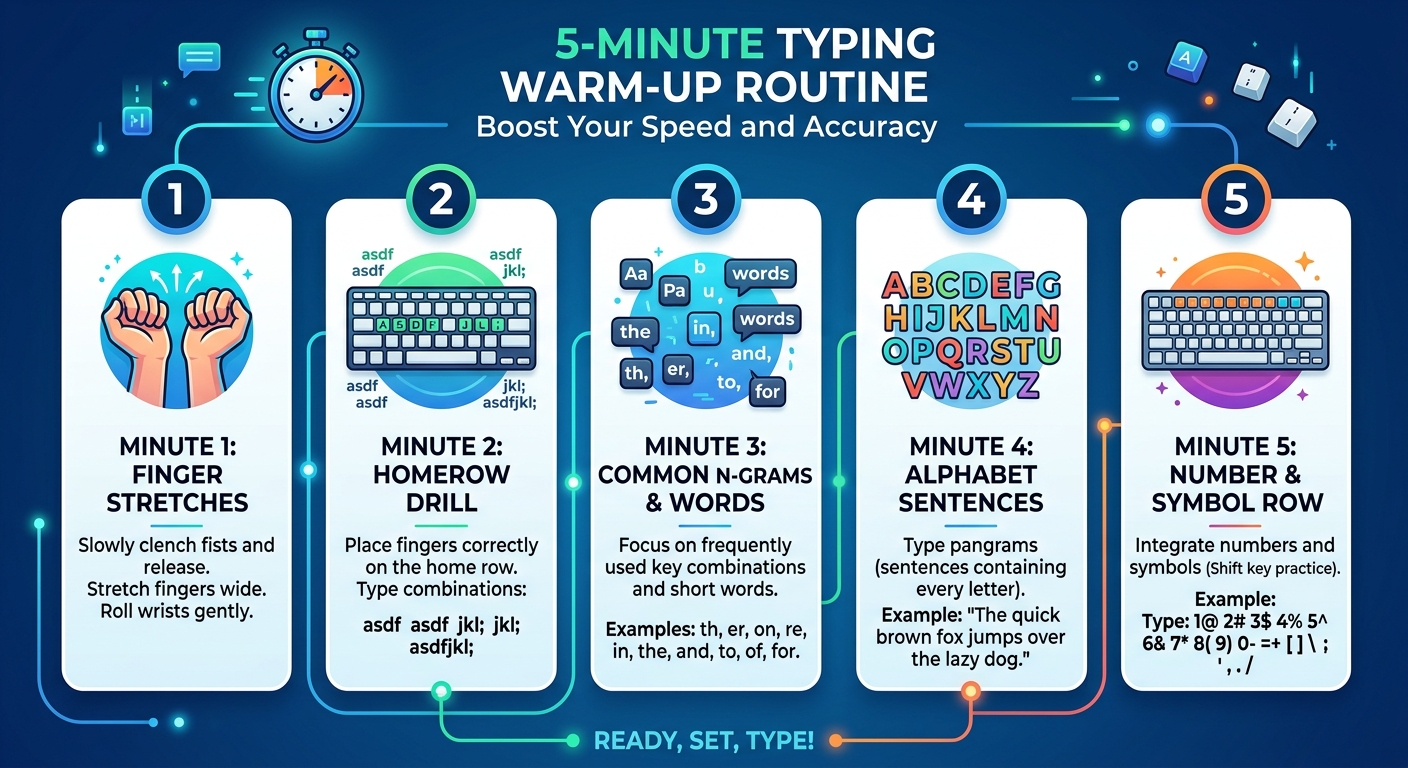
Here's the exact routine I use. Five minutes. Five drills. One minute each.
Set a timer. Focus on accuracy, not speed. This isn't practice. It's preparation.
Minute 1: Home Row Anchor
Place your fingers on the home row. A, S, D, F for the left hand. J, K, L, semicolon for the right hand.
Now type this slowly:
asdf jkl; asdf jkl; asdfg hjkl; asdfg hjkl;
Then this:
fjfj dkdk slsl a;a; fjfj dkdk slsl a;a;
Then close your eyes and do it again. Feel the bumps on F and J. Let your fingers find home without looking.
Why this works: This drill resets your hand position. It reminds your fingers where they belong. It also catches bad habits before they become mistakes.
Common mistake: Rushing. This minute is not about speed. It's about accuracy. If you're fast and sloppy, you've already failed the warm-up.
Minute 2: Top Row Reach
Now you're reaching up. Your index fingers lead the way.
Type this slowly:
qwer tyui qwer tyui qwerty uiop qwerty uiop
Then this:
qq pp ww oo ee ii rr uu tt yy
The goal is not speed. The goal is to reach with the correct finger and return to home row after each keystroke.
Why this works: The top row requires finger extension. Those muscles are cold at the start of a session. This drill warms them up.
Common mistake: Reaching with the wrong finger. Your left pinky owns Q. Your right pinky owns P. Your ring fingers own W and O. Your middle fingers own E and I. If you're using your index fingers for everything, this drill will expose that.
Minute 3: Bottom Row Wake-Up
The bottom row is the most awkward. That's why it needs the most warm-up.
Type this slowly:
zxcv bnm, zxcv bnm, zxcvb nm,./ zxcvb nm,./
Then this:
zz // xx .. cc ,, vv mm bb nn
The bottom row is where most typos happen. This drill forces you to reach down and return home.
Why this works: The bottom row requires finger flexion. Those muscles are even colder than the top-row muscles. Waking them up before you type seriously prevents the sloppy mistakes that happen in the first few minutes of typing.
Common mistake: Hitting the wrong key because you didn't return to home row. Slow down. Accuracy is everything.
Minute 4: Common Word Drill
Now you're stringing letters together. Type these twenty common words at a moderate pace.
the and that have with this from they will been their would there which when what about your them then
Don't rush. Don't sprint. Just type each word cleanly.
Then do it again. This time, focus on rhythm. Steady beat. No bursts.
Why this works: The 100 most common English words make up about 50% of all written text. Warming up on these words primes your fingers for the most frequent letter combinations.
Common mistake: Typing the same speed you'd type in a real session. This minute is about accuracy. Not speed.
Minute 5: Real Sentence Practice
Now you're typing real text. Open a typing test. Set it to 1 minute. Choose a random passage.
Type at 80% of your normal speed. Not 100%. Not 50%. Just enough to feel smooth and accurate.
Why this works: This final minute transitions your fingers from drill mode to real typing mode. It also gives you a baseline for the session ahead.
Common mistake: Trying to hit a record. This is a warm-up. The goal is to feel loose, not to set a personal best.
My 2-Week Test Results
I tracked my performance for two weeks before and two weeks after adding this warm-up to my routine. Here's what changed.
| Metric | Before Warm-Up | After Warm-Up | Change |
| First 10-min WPM | 62 | 78 | +16 |
| First 10-min accuracy | 89% | 95% | +6% |
| Total session WPM | 78 | 84 | +6 |
| Mistakes in first 5 min | 12 | 4 | -8 |
The biggest improvement was in the first ten minutes of each session. That's exactly where the warm-up is designed to help.
The total session WPM also improved. Why? Because starting strong means staying strong. A bad first ten minutes throws off your entire session.
Why This Matters for Race Performance
If you're racing on TypingBattles, the warm-up matters even more.
Most races are short. Thirty seconds. A minute. If you jump in cold, you're wasting your first few races just getting your fingers moving.
Warming up first means your first race is your best race. Not your fifth.
I tested this. Without a warm-up, my first race was around 78 WPM and my fifth was 92 WPM. With a warm-up, my first race was 94 WPM. No warm-up curve. Just peak performance from the start.
Customizing the Warm-Up for Your Skill Level
Not everyone needs the same warm-up. Here's how to adjust it based on where you are.
Beginners (Under 40 WPM)
Skip the speed-focused parts. Focus entirely on accuracy.
Modified routine:
- Minute 1: Home row anchor (slow)
- Minute 2: Home row + top row (slow)
- Minute 3: Home row + bottom row (slow)
- Minute 4: Common words (slow)
- Minute 5: One short sentence
You're not warming up for performance. You're reinforcing the basics. Take it slow.
Intermediate (40-70 WPM)
Use the standard routine. Focus on clean transitions and returning to home row.
Modified routine:
- Minute 1: Home row anchor
- Minute 2: Top row reach
- Minute 3: Bottom row wake-up
- Minute 4: Common words
- Minute 5: Real sentence practice
Stick to the 80% speed rule. Never sprint during a warm-up.
Advanced (70+ WPM)
Use the standard routine. Add a sprint at the end.
Modified routine:
- Minute 1: Home row anchor (fast)
- Minute 2: Top row reach (fast)
- Minute 3: Bottom row wake-up (fast)
- Minute 4: Common words (fast)
- Minute 5: One 1-minute sprint
Advanced typists warm up faster. If 5 minutes feels too long, compress it to 3 minutes by combining minutes 1-3 into a single drill.
Common Warm-Up Mistakes
Here's what to avoid.
Mistake 1: Skipping the warm-up. "I don't have time." You don't have time to waste the first ten minutes of your session either. The warm-up pays for itself.
Mistake 2: Going too fast. A warm-up is not a race. If you're sprinting during minute 1, you're not warming up. You're just typing.
Mistake 3: Ignoring posture. The warm-up is the perfect time to check your setup. Feet flat. Wrists floating. Screen at eye level. Fix it before you start.
Mistake 4: Typing the same drill every day. Variation keeps your brain engaged. Cycle through different home row patterns, different common words, and different real sentences.
Mistake 5: Skipping the last minute. Minute 5 is the most important. It transitions you from drills to real typing. Don't cut it short.
What If You Only Have 2 Minutes?
You don't always have five minutes. Here's a compressed version.
Minute 1: Home row + top row
Type asdf jkl; qwer tyui asdf jkl; qwer tyui. Then close your eyes and do it again.
Minute 2: Common words + real sentence
Type the twenty common words. Then type one sentence from a typing test.
That's it. Two minutes. Two drills. Enough to wake up your fingers.
It's not ideal. But it's better than nothing. And it's infinitely better than jumping in cold.
The Bottom Line
Athletes warm up. Musicians warm up. Surgeons warm up.
Typists should too.
The 5-minute routine I use isn't complicated. It's five simple drills. One minute each. It costs you five minutes. It saves you ten minutes of sloppy typing at the start of every session.
Try it for a week. Track your first-10-minute WPM and accuracy. Then tell me it doesn't work.
Your fingers will thank you.
Key Takeaways
- Warming up improves first-10-minute performance by 10-16 WPM.
- Cold muscles type slowly. Warm muscles type faster and more accurately.
- The 5-minute routine: home row, top row, bottom row, common words, real sentence.
- Focus on accuracy, not speed, during the warm-up.
- Adjust the routine based on your skill level.
- Two-minute version exists for busy days.
- Warm up before racing. Your first race will be your best race.
Author Bio
Abid is a competitive typist on TypingBattles (105 WPM, 400+ wins). He used to skip warm-ups entirely. Then he noticed his first ten minutes of every session were terrible. Now he warms up religiously. His wife thinks it's weird. He types faster than her, so he doesn't care.
Recommendation
Warmed up? Good. Now test your speed.
TypingBattles shows your WPM in real-time. Race real opponents. See how fast you are when it counts.