I want to tell you about the most confusing moment of my typing life.
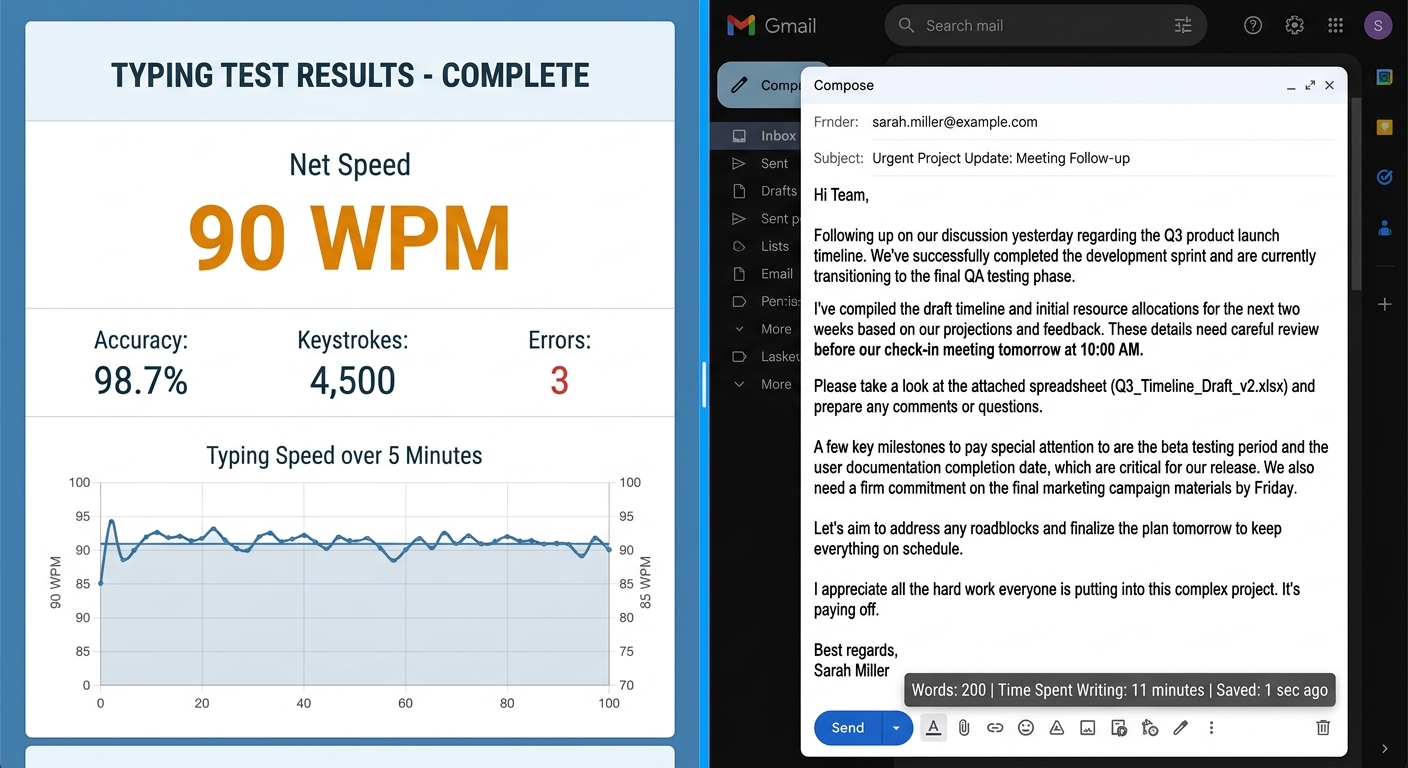
I'd just hit 92 WPM on a typing test. Personal best. I felt unstoppable. I was ready to write anything.
Then I sat down to write a client proposal.
Two hundred words in, I stopped and looked at the clock. I'd been typing for eleven minutes. That's roughly 18 WPM. Not 92. Not even close.
I stared at the screen. Something was wrong. Either the test was lying, or I was.
Turns out, neither. They just measure different things.
If you've ever felt this same confusion — fast on tests, slow in real life — you're not broken. You're experiencing one of the most misunderstood realities of typing speed.
Let me explain.
What a Typing Test Actually Measures
A typing test measures one specific thing. Mechanical transcription speed.
Here's what happens during a test. The text is put in front of you. Your job is to reproduce it. That's it.
- See the next character
- Press the corresponding key
- Repeat
No thinking. No decision-making. No creativity. No editing. No formatting. No moving your hand to grab the mouse. No switching windows to check a fact.
Just pure motor execution.
That's what a typing test measures. Your fingers' raw ability to reproduce text you're looking at. Nothing more. Nothing less.
Why the Test Is Accurate (For What It Measures)
The test isn't lying to you. It's measuring something real. Your fingers genuinely can move at 92 WPM when they're given simple, uninterrupted text to reproduce.
That speed is your peak mechanical capacity. It's a real number. It's a useful number. It just doesn't tell the whole story.
What Real-World Typing Actually Involves
Now let's talk about what happens when you sit down to write something real.
You're not just transcribing. You're doing ten things at once.
Choosing words. What's the right word here? "Important" or "crucial" or "vital"? That decision takes time.
Constructing sentences. How do you structure this paragraph? What's the flow? Where does the comma go?
Considering tone. Is this too formal? Too casual? Will the client read this as aggressive or confident?
Recalling context. What did they say in the last email? What was the budget number? What's the deadline?
Editing as you go. That sentence didn't work. Backspace. Rewrite. Try again.
Formatting. Bold this. Italicize that. Make it a bullet list. Add a link.
Switching windows. Check Slack. Reply to a message. Look at the reference document.
The typing itself is maybe 20% of the total cognitive load. Your fingers can outrun your brain easily. And when they do, you stop. You think. You decide. Then you type again.
That's not slow typing. That's thinking.
A Concrete Example
Let me show you what I mean.
Imagine you're typing this sentence: "The proposal deadline is Friday."
Typing test version: The text is on screen. You type it. It takes 2 seconds at 90 WPM.
Real-world version: You're writing an email to a client. You think about whether to lead with the deadline or bury it. You consider using "Friday" or "this Friday" or "end of week." You wonder if you should mention the specific time. You decide whether to add context about why. You check the calendar to make sure Friday is correct. Then you type the sentence.
Total time: 30-45 seconds.
The typing portion is 2 seconds. The other 28-43 seconds are thinking, deciding, checking, and second-guessing.
That's the difference.
The Other Real-World Speed Killers
Beyond the thinking, there are other things that slow you down in real life that don't exist in a test.
Mouse Switches
Every time you move your hand from keyboard to mouse and back, you lose about a second. Sounds small. But in a real work session, you might do this 50-100 times.
That's 50-100 seconds lost. Almost two minutes. Gone. Not because you typed slowly. Because you switched inputs.
Formatting Interruptions
Bold. Italic. Lists. Headers. Links. Tables. Every formatting action breaks your typing flow. You stop typing to click a button or use a keyboard shortcut. Then you have to find your place again.
In a typing test, none of this exists. In real work, it's constant.
Special Characters
If you're writing code, doing math, or writing in a non-English language, you're typing characters that aren't in the top 200 English words. Bracket keys. Symbols. Accented letters. Each one costs extra time.
A typing test uses common English text. Real work doesn't.
Auto-Correct Fights
You type something correctly. The software "fixes" it. Now you have to go back and fix the fix.
Or you're typing quickly and auto-correct misses your mistake entirely. So you type the next word, then have to stop, go back, and correct.
Every correction is time lost.
App Switching
Copy from a reference document. Paste into your draft. Switch back to reference. Copy another section. Paste. Check the fact. Open a browser tab. Find the source. Copy. Paste.
This is real work. And none of it happens in a typing test.
Rereading and Revising
You finish a paragraph. You reread it. Something's off. You reword. You move a sentence. You delete a phrase.
The typing test doesn't make you reread anything. You type what's on screen. Real work requires constant review.
The Real Math: What Your Effective Speed Actually Is
Here's the truth that most typing sites won't tell you.
Your real-world effective speed is usually 30-50% of your test speed.
A 90 WPM tester writes emails at around 35-45 effective WPM. That's not a failure. That's normal. It's the reality of thinking and typing at the same time.
Let me show you a breakdown for a typical writing session.
| Activity | Percentage of Time |
| Actual typing | 20-30% |
| Thinking and word choice | 25-35% |
| Rereading and revising | 15-20% |
| Mouse switching and formatting | 10-15% |
| Editing (backspace, reword) | 10-15% |
Even the fastest typists spend more time thinking than typing. That's not a bug. That's the job.
Why This Confusion Matters
Here's why I care about this.
People judge themselves based on test scores. They hit 90 WPM in a test, then feel like failures when they write slower at work. They think something is wrong. They think they're not actually fast.
But they are. Their mechanical speed is real. Their real-world speed is just a different measure. And it's a more honest one.
Because at the end of the day, typing speed doesn't matter for its own sake. It matters because it helps you get things done. And getting things done requires thinking, deciding, and creating. Not just transcribing.
What This Means for Your Practice
So what should you do with this information?
Don't Stop Practicing
Higher mechanical speed is still valuable. Here's why.
When typing becomes truly automatic, your brain is freed up for the thinking that actually matters. You stop using cognitive resources on finding keys. Those resources go to word choice, structure, and ideas.
That's the real productivity unlock. Not the WPM number itself. The fact that your fingers can keep up with your thoughts.
Measure the Right Thing
If you want to know your real-world typing productivity, measure output. How many words did you actually write in an hour? Not how fast your fingers can move. How many finished, meaningful words did you produce?
For most people, that number is 300-800 words per hour. Depending on the type of writing and how much thinking is required.
Compare that to typing test WPM × 60. That gives you the theoretical maximum. Your real number will be much lower. And that's fine.
Practice Real Writing, Not Just Tests
This is the secret that typing test enthusiasts miss.
If you want to be fast at real typing, practice real typing. Write emails. Write articles. Write code. Write journal entries. Write anything that requires thinking and typing at the same time.
That trains the whole system, not just the fingers.
Typing tests train your fingers. Real writing trains your brain-finger coordination. Both matter. But only one prepares you for actual work.
Use Competitions for Pressure Training
Here's where competitive typing comes in.
Racing real opponents on TypingBattles adds something a typing test can't replicate — pressure. And pressure is what you actually face in real work.
A deadline. A client waiting. A coworker needing a response. All of these create pressure. Training under pressure makes you better at handling pressure.
So use tests for mechanical speed. Use competitions for pressure training. Use real writing for the actual skill.
My Personal Reality Check
After I figured all this out, I ran a test on myself.
I tracked my output for two weeks. I logged every word I wrote at work. Emails, reports, proposals, messages.
My average? Around 620 words per hour.
My typing test score at the time? Around 95 WPM. Which is 5,700 words per hour.
That meant my effective output was about 11% of my mechanical capacity. Which sounds terrible. Until I realized the numbers were completely normal.
The other 89% was thinking, deciding, rewriting, and doing the actual work of writing.
I stopped feeling bad about my "slow" real-world speed. I started understanding what was actually happening.
The Bottom Line
Your typing test score doesn't match your real-world speed. That's not a bug. It's the nature of the two activities.
Typing tests measure mechanical transcription. Real work requires thinking, deciding, editing, and formatting. Both are valuable. They're just different.
Stop comparing your test score to your writing speed. They were never meant to be the same number.
Use tests to track your mechanical progress. Use real writing to practice your actual productivity. And use competitions to train under pressure.
Then, when someone asks why your test score is so much higher than your real-world output, you'll know the answer.
And you'll be right.
Key Takeaways
- Typing tests measure mechanical transcription speed. They don't measure thinking, deciding, or editing.
- Real-world typing involves 10+ cognitive tasks happening simultaneously.
- Your effective real-world speed is 30-50% of your test speed. That's normal.
- Mouse switches, formatting, and app switching all kill your effective speed.
- Higher mechanical speed is still valuable because it frees cognitive resources for thinking.
- Practice real writing, not just tests to build brain-finger coordination.
- Competitions train pressure performance, which is what real work requires.
Author Bio
Abid is a competitive typist on TypingBattles (105 WPM, 400+ wins). He hit 92 WPM on a test once, then spent 11 minutes writing 200 words. The confusion led to this article. He now measures his productivity in finished work, not test scores. His wife says that's healthier.
Recommendation
Ready to test both your mechanical speed and your pressure tolerance?
Take a typing test. Then race real opponents. See how you perform when it actually counts.