I remember the exact moment I realized I didn't understand my own typing score.
I was comparing results with a friend. I typed 400 characters in a minute. He typed 380. But the test said he was faster. That made no sense to me.
Turns out, I was making a lot of mistakes. He wasn't. And the formula wasn't counting what I thought it was counting.
That sent me down a rabbit hole. How does a typing test actually calculate WPM? What counts as a "word"? Why do different tests give different scores for the same performance?
Let me save you the confusion.
What "WPM" Actually Means
WPM stands for words per minute. Sounds straightforward. Count the words. Divide by the minutes.
But here's the problem. What counts as a word?
Is "I" a word? Yes. Is "antidisestablishmentarianism" a word? Yes. But they're very different lengths. If a test used actual word counts, someone typing short words would score higher than someone typing long words. That's unfair.
So the typing industry came up with a standardized solution.
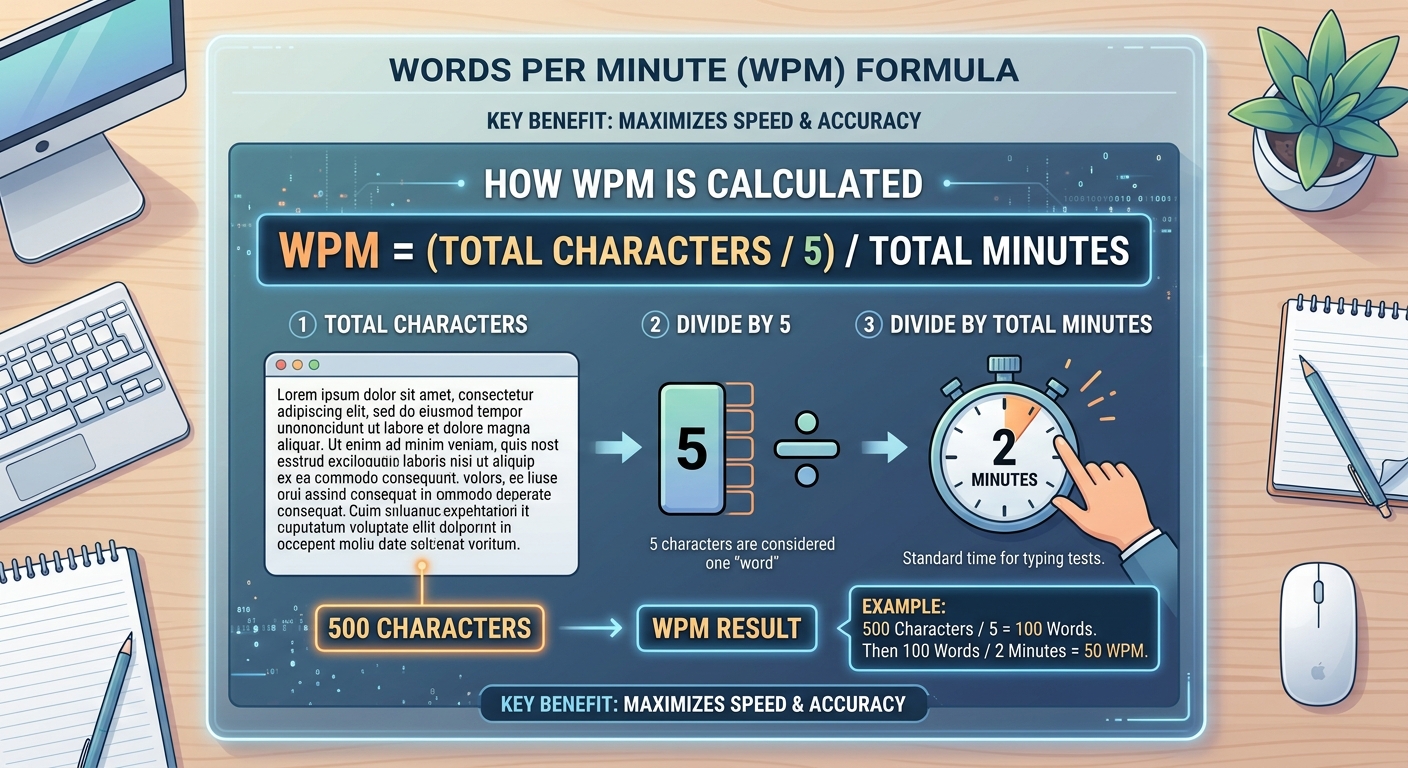
One word = five characters.
That's it. That's the magic number. Every modern typing test uses this formula. It's been the standard since the 1900s because it makes results comparable regardless of what text you're typing.
The Basic Formula
Here's the core calculation.
WPM = (characters typed ÷ 5) ÷ minutes elapsed
Let me walk through an example.
You type 350 characters in one minute.
350 ÷ 5 = 70
70 ÷ 1 = 70 WPM
Simple, right?
Now let's say you type 700 characters in two minutes.
700 ÷ 5 = 140
140 ÷ 2 = 70 WPM
Same speed. Different duration.
The formula normalizes everything to "words per minute" using the 5-character standard.
Why 5 Characters = 1 Word?
The average length of an English word is about 4.7 characters. Add a space between words, and it's roughly 5 characters per word.
So "5 characters = 1 word" is an approximation. It's not perfect. But it's objective and consistent.
Here's why that matters.
Imagine two tests. One uses only short words like "the," "and," "cat." The other uses long words like "elephant," "necessary," "understanding."
If you used actual word counts, the short-word test would give you a much higher WPM. That's misleading.
But if you use the 5-character standard, both tests produce comparable scores. A character is a character. Length doesn't matter.
Gross WPM vs Net WPM
This is where things get interesting.
There are two ways to calculate WPM. Gross and net.
Gross WPM
Gross WPM counts every character you type. Mistakes don't matter.
Gross WPM = (total characters ÷ 5) ÷ minutes
If you type 400 characters in a minute, your gross WPM is 80. Even if 50 of those characters were wrong.
Gross WPM tells you how fast your fingers moved. It doesn't tell you how effective you were.
Net WPM
Net WPM subtracts a penalty for errors.
Net WPM = ((total characters ÷ 5) - uncorrected errors) ÷ minutes
If you type 400 characters with 20 errors in one minute, your net WPM is:
(400 ÷ 5) - 20 = 80 - 20 = 60 WPM
Net WPM tells you your effective speed. It's what actually matters.
Which One Do Typing Tests Use?
Most modern typing tests use net WPM. But they calculate it differently.
The older method subtracts errors. The newer method only counts correct characters.
Modern formula: Only correctly typed characters count toward your score. If you type a wrong character and don't fix it, that character doesn't count at all.
This is stricter. And it's more accurate. Because let's be honest. If you type a wrong character and leave it, you didn't actually type that word correctly.
How Accuracy Is Calculated
Accuracy is simpler than WPM.
Accuracy % = (correct keystrokes ÷ total keystrokes) × 100
If you typed 400 characters and 20 were wrong, your accuracy is:
(380 ÷ 400) × 100 = 95%
Accuracy measures how clean your typing was. It doesn't care about speed. Just correctness.
Why Your WPM Varies Between Tests
You take a test. You get 70 WPM. You take another test. You get 62 WPM. What happened?
Several things can affect your score.
Text difficulty. Uncommon words slow you down. If the test uses complex vocabulary, your WPM drops.
Capital letters and punctuation. Shift-key combinations add friction. Typing "hello" is faster than typing "Hello, world!"
Test length. Short tests favor sprinters. Long tests reward consistency.
Fatigue. Speed drops over longer sessions. Your first minute is faster than your fifth.
Warm-up. Cold fingers type slower. If you didn't warm up, your score suffers.
Nerves. If you're anxious, your fingers tense up. Relaxed typing is faster.
Keyboard. A mechanical keyboard with good feedback might give you a slight edge over a mushy membrane board.
Time of day. Most people type faster in the morning than late at night.
The lesson? Don't judge your speed based on one test. Take multiple tests. Use the average.
Worked Example: From Start to Finish
Let me show you a complete calculation.
The scenario:
- You type for 2 minutes
- You type 600 total characters
- 15 characters are wrong (and not corrected)
- 585 characters are correct
Step 1: Calculate gross WPM
600 ÷ 5 = 120
120 ÷ 2 = 60 gross WPM
Step 2: Calculate net WPM
585 ÷ 5 = 117
117 ÷ 2 = 58.5 net WPM
Step 3: Calculate accuracy
585 ÷ 600 = 0.975
0.975 × 100 = 97.5% accuracy
Your results:
- Gross WPM: 60
- Net WPM: 58.5
- Accuracy: 97.5%
Not bad. But you can see how errors affect your net WPM. If you had zero errors, your net WPM would be 60. The 15 errors cost you 1.5 WPM.
Now imagine you had 50 errors instead of 15.
Net WPM would be:
(550 ÷ 5) ÷ 2 = 55 WPM
That's a 5 WPM drop. Significant.
This is why accuracy matters. Every error eats into your effective speed.
How TypingBattles Calculates WPM
Different platforms calculate WPM slightly differently. Here's how TypingBattles does it.
Only correctly typed characters count. If you type a wrong character, it doesn't count toward your score. Fixing it adds time to your clock.
The timer starts when you press the first key. Not when the test begins. This gives you control over when your time starts.
The timer ends when you finish or time runs out. Your total elapsed time determines your final WPM.
Final WPM uses your total elapsed time. No shortcuts. No gaming the system.
This method is strict. But it's fair. It rewards accuracy and speed equally.
Keystrokes Per Hour (KPH)
Some jobs measure typing speed in keystrokes per hour instead of WPM.
KPH = characters typed per hour
To convert WPM to KPH, multiply by 300.
KPH = WPM × 300
Why 300? Because 1 WPM = 5 characters per minute = 300 characters per hour.
If you type 60 WPM, your KPH is 18,000.
Data entry jobs often use KPH because it measures actual keystrokes, not "words."
The Bottom Line
WPM isn't as simple as counting words. It's a standardized formula based on characters. One word equals five characters. Always.
Understanding the math helps you interpret your scores more accurately. It also helps you see where you can improve.
If your net WPM is much lower than your gross WPM, focus on accuracy. If they're close, focus on speed.
Either way, now you know exactly how the number is calculated. No more mystery.
Key Takeaways
- 1 word = 5 characters in typing test math.
- Gross WPM counts all characters. Net WPM penalizes errors.
- Modern tests only count correctly typed characters.
- Accuracy = (correct keystrokes ÷ total keystrokes) × 100.
- WPM varies based on text difficulty, length, fatigue, and warm-up.
- KPH = WPM × 300 for data entry calculations.
- Take multiple tests and average them for an accurate picture.
Author Bio
Abid is a competitive typist on TypingBattles (105 WPM, 400+ wins). He spent an entire evening figuring out how WPM is calculated. His wife thought he was losing his mind. He was. But now he understands the math, and he's sharing it so you don't have to suffer.
Recommendation
Now that you know how WPM is calculated, test your own speed.
TypingBattles shows your gross WPM, net WPM, and accuracy. Then race real opponents to see how you perform under pressure.